
"Pharmaplast began to work with CE.way almost one year ago. CE.way is our cosmetics consultant who look after compilation of PIF, safety assessments and CPNP notifications. Working with CE.way has been a joy so far. Their replies are very swift and Mr Tadej is very cooperative, helpful and with a deep knowledge about the cosmetics regulations."
NMPA regulations
China Cosmetic Regulations
Navigate China's cosmetic registration system with confidence — from NMPA pre-market registration for special use cosmetics to filing with provincial MPAs.
SAMRNMPATechnical Safety Standard 2015IECIC 2015
China · NMPA
CE.way helps cosmetic brands comply with China cosmetic regulations, including NMPA product registration and filing, formula review against IECIC, labelling requirements under GB 5296.3-2008, laboratory testing at NMPA-authorized labs, and Chinese Responsible Agent and Responsible Person services — under one roof.
15 years
of experience
40+ countries
client base
IE100 Awards Winner 2026
4.8 / 5
Trustpilot rating
Requirements overview
What do you need for China?
A summary of the key requirements before placing cosmetic products on the Chinese market.
01
NMPA Registration (SUC)
Imported and domestic Special Use Cosmetics require pre-market registration with NMPA before the product can be placed on the Chinese market.
02
NMPA / MPA Filing (non-SUC)
Non-Special Use Cosmetics require pre-market filing with NMPA or with provincial MPAs for manufacturers registered in the 11 Free-Trade Zones.
03
Chinese Responsible Agent / Person
Foreign manufacturers must appoint a Chinese Responsible Agent (for SUC) or Chinese Responsible Person (for non-SUC) to handle registration and filing.
04
IECIC Formula Compliance
All intentionally used ingredients must be listed in the Inventory of Existing Cosmetic Ingredients in China (IECIC 2015) or undergo new ingredient registration.
05
NMPA Laboratory Testing
Even products tested abroad must be retested in NMPA-authorized laboratories in China, including toxicological and human safety tests for SUC products.
06
Labelling (GB 5296.3-2008)
Chinese cosmetic labels must comply with national standard GB 5296.3-2008 and are reviewed by both NMPA and CIQ upon product arrival in China.
Our services
How we can help
A full range of regulatory services tailored for the Chinese cosmetic market.
01
Product Classification
Determine whether your product is a Special Use or Non-Special Use Cosmetic under Chinese regulations.
02
Formula Review
Ingredient-by-ingredient review against IECIC 2015 and the Hygiene Standard for Cosmetics 2007, including permitted preservatives, UV filters, colorants, and hair dyes.
03
Labelling Review
Full compliance check against the national standard GB 5296.3-2008 for Chinese cosmetic labelling requirements.
04
Registration & Filing Documentation
Preparation of the complete registration dossier for NMPA or filing documentation for provincial MPAs, including all required technical files.
05
Laboratory Testing at NMPA Laboratories
Coordination of required product testing at NMPA-authorized laboratories in China, including toxicological assessments and human safety tests for SUC products.
06
Chinese Responsible Agent / Person Service
We act as your third-party legal agent (Chinese Responsible Agent) for SUC registration or Chinese Responsible Person for non-SUC filing procedures.
Regulatory framework
Applicable legislation
Regulatory framework
Applicable legislation
Cosmetic regulations in China are supervised by 2 main competent authorities: State Administration for Market Regulation (SAMR) and the independent Drug Administration Bureau called National Medical Products Administration (NMPA), which is under the governance of SAMR. Furthermore, NMPA consists of 9 subordinate departments, including Cosmetic Safety Supervision department. At provincial level and under NMPA, there are Medical Products Administrations (MPAs), which are in charge of filing of domestic non-special use cosmetics and issuance of cosmetics manufacturers' production license.
The current regulatory system in China is founded on the Regulations concerning the Hygiene Supervision over Cosmetics from 1989. There are multiple laws that have to be followed and taken into account in China, but the most important is the Technical Safety Standard for Cosmetics 2015 which replaced the Hygiene Standard for Cosmetics 2007.
Product scope
What type of products are cosmetics?
Product scope
What type of products are cosmetics?
Cosmetic products are defined as "Products which can be spread on the outer surface of the human body (e.g. skin, hairs, nails, lips etc.), the teeth and oral mucosa for the purpose of cleaning, protecting, beautifying, deodorizing and keeping in good condition, by way of smearing, spraying or other similar means".
Cosmetic products are then further divided into non-special use cosmetics (non-SUC) and special use cosmetics (SUC). Non-special use cosmetics include skin care products, hair care products, nail care products, make-up and perfumes. Special use cosmetics, on the other hand, include products such as hair growth products, hair dyes, hair perming products, depilating products, breast beauty products, slimming products, deodorants, freckle-removing products, sunscreens and whitening products. Some products may fall into both categories and their classification depends on their composition.
Soaps, toothpaste and oral cleansers are not, however, considered cosmetics and they can be imported directly into China after customs clearance.
Regulatory requirements
Requirements

Regulatory requirements
Requirements
Cosmetic products marketed in China need to get approval from NMPA or provincial MPAs. Rules and requirements differ depending on whether the product is special use or non-special use cosmetic and they are also different for imported and domestic products.
Imported SUC products require a pre-market registration and can only be imported after getting approval from NMPA. On the other hand, non-SUC products require a pre-market filing and can be imported after the filing has been finished while the technical review is carried out during post-market surveillance.
Registration process - SUC
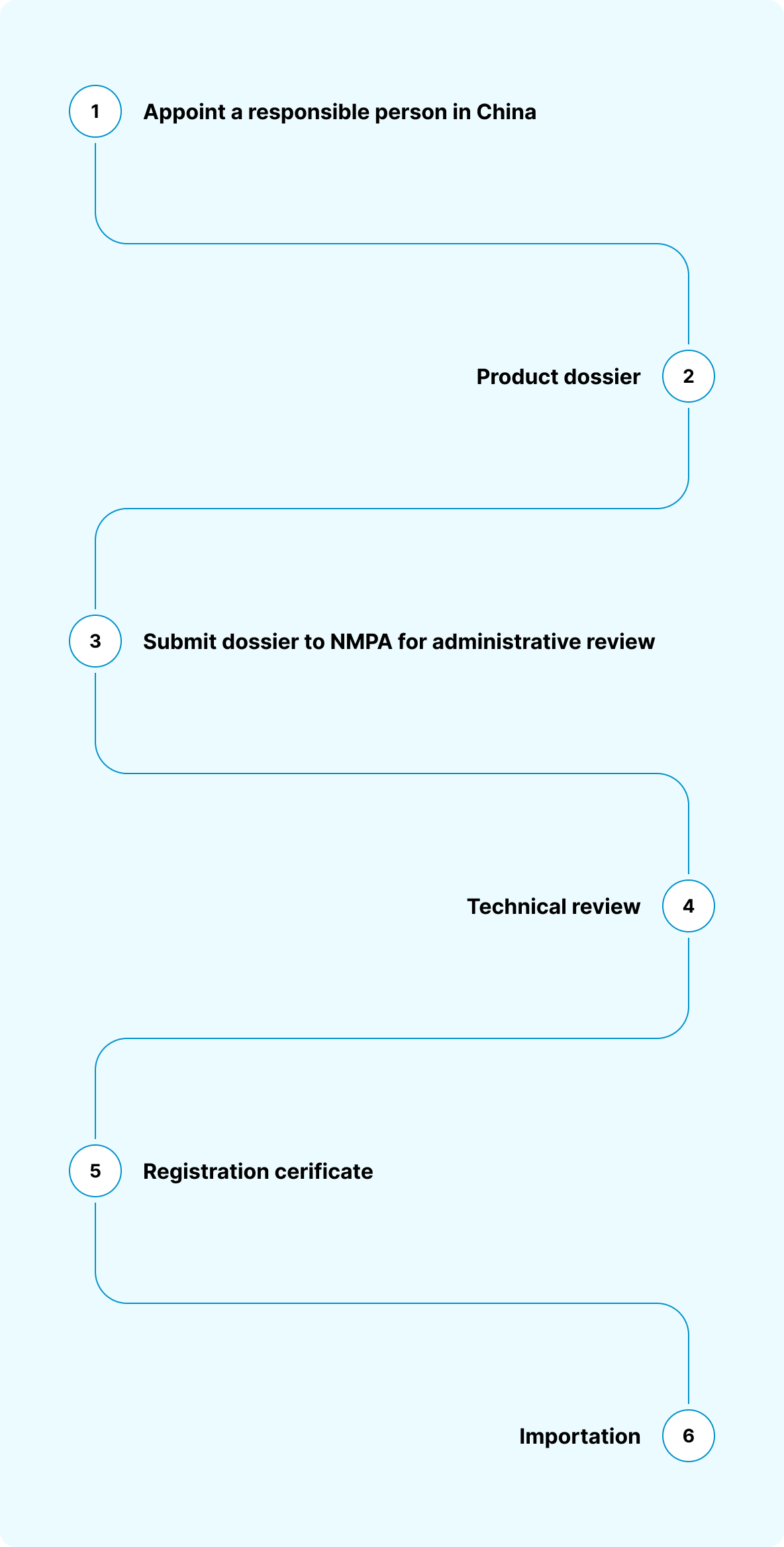
Imported SUC, domestic SUC and new cosmetic ingredients require a pre-market registration with NMPA. Foreign manufacturers that want to import SUC products into China need to assign a Chinese Responsible Agent who would then take care of the SUC product registration procedures. The Chinese Responsible Agent can be any legal entity registered in China.
Before the registration process is undertaken it is advisable to check the formula to see whether it complies with the Chinese legislation or not. NMPA maintains an Inventory of Existing Cosmetic Ingredients in China (IECIC - current version 2015). Furthermore, the Hygiene Standard for Cosmetics 2007 lists the restrictions for ingredients, their maximum permitted concentration, warnings etc. It lists the permitted preservatives, UV filters, colorants and hair dyes. New ingredients, which are not listed in IECIC, need to undergo a stringent and time-consuming pre-market registration procedure.
The next step is product testing. Even if cosmetic products have already been tested abroad, they will have to be tested again in one of the NMPA authorized laboratories in China. Toxicological tests are performed using animals. SUC products have to meet strict requirements and the testing part also includes human safety tests.

A registration dossier must then be submitted to NMPA for review. NMPA will conduct a format review or completeness check first and then a technical review. The product information file must contain the following:
- NMPA registration form
- Quantitative and qualitative formulation
- Indication of active ingredients and their functions
- Method of manufacture
- Test certificates (from NMPA accredited laboratory)
- Product specification and test methods
- Toxicity testing
- Free sales certificate
- Authorization letter for the local agent to apply for registration
- Chinese label copy
- Declaration of absence of ingredient with BSE risk
- Sample
NMPA will extensively review the product label. Product name and labels will also be checked by CIQ (China Inspection and Quarantine Bureau) when products arrive to China. Cosmetics must be labelled according to the national standard GB 5296.3-2008.
Filing process - non-SUC

Filing process - non-SUC
Imported non-SUC are subject to pre-market filing with NMPA and domestic non-SUC are subject to pre-market filing with provincial MPAs.
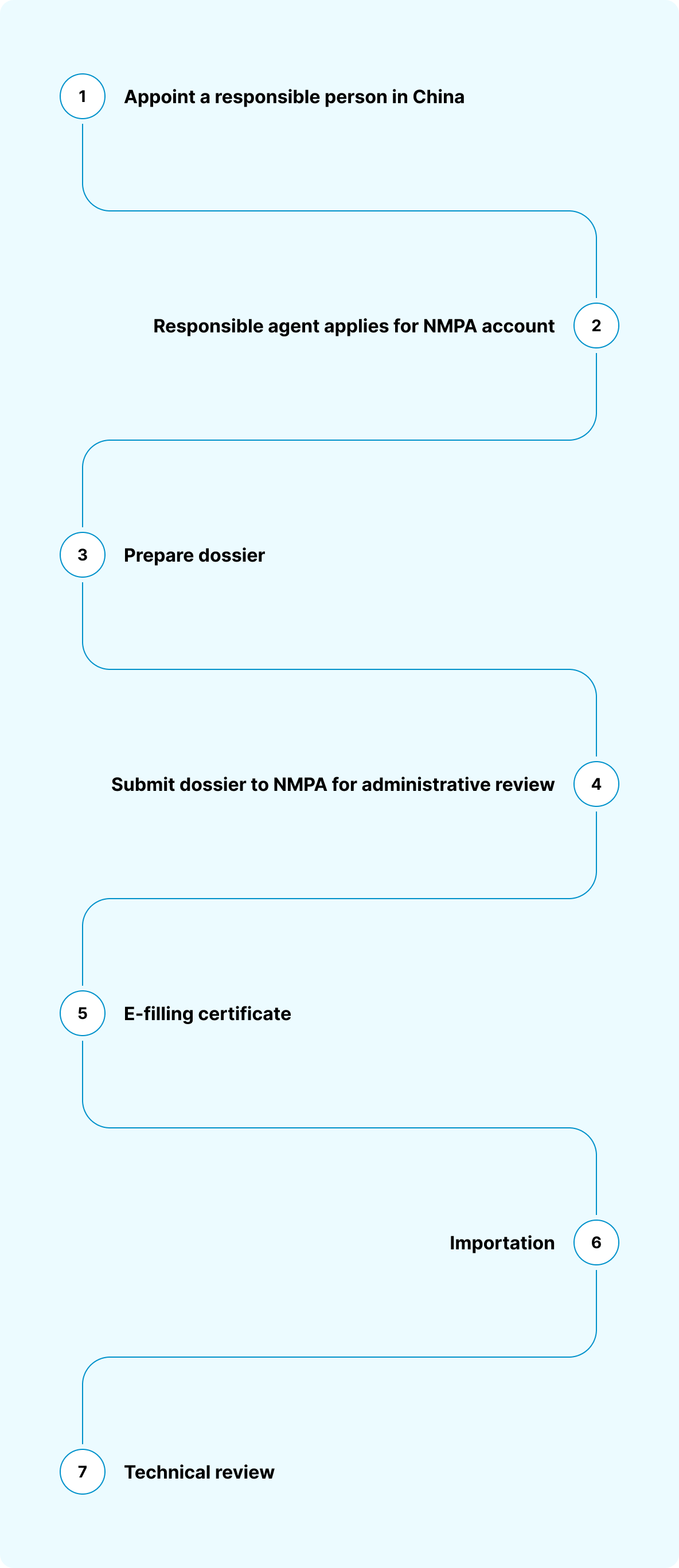
Foreign manufacturers that want to import non-SUC products into China need to assign a Chinese Responsible Person who would take care of the non-SUC product filing procedures. The Chinese Responsible Person must have cosmetic business licence and importation qualification and needs to be the importer. After assigning the RP and applying for NMPA account, the next step is testing the product, which must be conducted in NMPA accredited labs in China. After obtaining the testing reports, the dossier can be compiled and submitted online by the RP.
RPs that are registered in Tianjin, Liaoning, Shanghai, Zhejiang, Fujian, Henan, Hubei, Guangdong, Chongqing, Sichuan or Shanxi can file to provincial MPAs. RPs that are registered outside the 11 Free-Trade Zones need to file to NMPA.
NMPA or provincial MDA will first conduct administrative review. After the approval, the RP can obtain E-Filing certificate (with no expiry date) online and start importing the products through the local ports. Technical review is carried out within 3 months after filing. The authorities can then approve or demand supplementary data, which has to be provided within 30 days.
Registration process diagrams
SUC registration process
Non-SUC filing process
Registration at a glance
Requirements summary
A short summary of the registration requirements for various types of cosmetic products.
| Origin | Category | Obligations | Certificate | Who applies? | Competent authority |
|---|---|---|---|---|---|
| Foreign | non-SUC | Pre-market online filing | E-filing certificate | Chinese responsible person | NMPA or MPAs in the 11 Free-Trade Zones |
| Foreign | SUC | Pre-market registration | Administrative permit certificate | Chinese responsible agent | NMPA |
| Domestic | non-SUC | Domestic filing | No certificate | Chinese manufacturer | Provincial MPAs |
| Domestic | SUC | Pre-market registration | Administrative permit certificate | Chinese manufacturer | NMPA |
Why CE.way
Why brands choose CE.way for China?
From startups to established brands, we help companies navigate the Chinese market with confidence.
International compliance expertise
Serving clients across 40+ countries with deep regulatory knowledge.
Fast turnaround times
Efficient preparation of registration dossiers and filing submissions to meet NMPA timelines.
In-house laboratory support
Our own lab in Slovenia supports safety testing and coordinates with NMPA-authorized laboratories in China.
Experience with China requirements
Proven track record with NMPA registrations, IECIC formula reviews, and Chinese Responsible Agent services.
Support for startups and established brands
Flexible services for first-time exporters entering China and large multi-SKU portfolios alike.
Getting started
What's the process?
Three steps to launch compliant cosmetics in China.
01
Share your product details
Formulas, labels, target market. A short discovery call is enough to scope your project.
02
We review compliance requirements
Ingredient review, label compliance, safety substantiation, NMPA registration or filing — handled end-to-end.
03
Launch your products in China
Receive support for compliant market entry, with ongoing Chinese Responsible Agent or Responsible Person coverage.
China cosmetics regulations
FAQ
Cosmetics in China are regulated by National Medical Products Administration (NMPA), which operates under the State Administration for Market Regulation (SAMR). The primary regulatory framework is the Technical Safety Standard for Cosmetics 2015, which replaced the Hygiene Standard for Cosmetics 2007, together with regulations dating back to the Regulations concerning the Hygiene Supervision over Cosmetics 1989.
Cosmetic products in China are defined as products spread on the outer surface of the human body (skin, hair, nails, lips, etc.), the teeth and oral mucosa, for the purpose of cleaning, protecting, beautifying, or deodorizing. Soaps, toothpaste, and oral cleansers are not considered cosmetics and can be imported directly after customs clearance.
Special Use Cosmetics (SUC) are products with specific functional claims, including:
- Hair growth products
- Hair dyes and hair perming products
- Depilating products
- Breast beauty products
- Slimming products
- Deodorants
- Freckle-removing products
- Sunscreens and whitening products
All other cosmetics — including skin care, hair care, nail care, make-up, and perfumes — are classified as Non-Special Use Cosmetics (non-SUC).
Imported SUC products require pre-market registration with NMPA before they can enter the Chinese market. The registration dossier must include:
- NMPA registration form
- Full quantitative and qualitative formulation
- Test certificates from NMPA-accredited laboratories
- Toxicity testing results
- Free sales certificate from the country of origin
- Chinese label copy compliant with GB 5296.3-2008
- Authorization letter for the Chinese Responsible Agent
Imported non-SUC products are subject to pre-market filing with NMPA. A Chinese Responsible Person must be assigned to manage the filing. After obtaining testing reports from NMPA-accredited labs, the dossier is submitted online. RPs registered in one of the 11 Free-Trade Zones (Tianjin, Liaoning, Shanghai, Zhejiang, Fujian, Henan, Hubei, Guangdong, Chongqing, Sichuan, or Shanxi) can file with provincial MPAs; all others must file with NMPA.
Yes. Foreign manufacturers must appoint a Chinese representative to handle regulatory procedures:
- Chinese Responsible Agent (for SUC): any legal entity registered in China that handles pre-market registration with NMPA.
- Chinese Responsible Person (for non-SUC): must hold a cosmetic business licence and importation qualification, and must be the importer.
All intentionally used ingredients must be listed in the Inventory of Existing Cosmetic Ingredients in China (IECIC 2015). The Hygiene Standard for Cosmetics 2007 lists restricted ingredients, maximum permitted concentrations, required warnings, and permitted preservatives, UV filters, colorants, and hair dyes. New ingredients not listed in IECIC must undergo a stringent pre-market registration procedure with NMPA.
All cosmetic products must be tested in NMPA-authorized laboratories in China, even if they have already been tested abroad. Toxicological tests are performed using animals. SUC products face stricter requirements that additionally include human safety tests. Testing must be completed before submitting the registration or filing dossier.
Cosmetics sold in China must be labelled in Chinese in accordance with the national standard GB 5296.3-2008. NMPA reviews product labels as part of the registration and filing process. CIQ (China Inspection and Quarantine Bureau) also checks product names and labels when products arrive at Chinese ports.
To navigate Chinese regulations effectively, companies typically rely on professional support services such as:
- Product classification (SUC vs. non-SUC)
- Formula review against IECIC and the Hygiene Standard
- Labelling review (GB 5296.3-2008)
- Preparation of the NMPA registration or filing dossier
- Laboratory testing coordination at NMPA-authorized labs
- Chinese Responsible Agent / Person service
These services help ensure full compliance, reduce risk, and support successful entry into the Chinese market.
Client reviews
Trusted by 1000+ cosmetic brands worldwide.
Pulled from verified Google reviews — independent, unedited, and updated continuously.
"We were looking for a stand-alone service, not too sure what to expect... The professionalism, the assistance and the responsiveness were very much appreciated, amongst the best we have ever experienced."
"We are a small manufacturing company located in the US. We recently used CE.way Regulatory Consultants to help guide us through the Cosmetic regulatory changes that have taken place in the EU. They were instrumental in helping us understand the new laws and streamline the entire process. I would highly recommend their services."
1 / 5
Get started
Ready to launch your cosmetic products in China?
Speak with our regulatory experts about China compliance, NMPA registration, testing, and Chinese Responsible Agent requirements.

